
Peer-review process
Updated: 21 October 2025
Peer review is a system for assessing and improving the quality of a manuscript before publication.
The pre-screening of manuscripts is carried out in three rounds by the Editorial Secretary and two Editors of the Editorial Office. We select manuscripts for peer-review on the basis of a Formal and a Professional Pre-screening Checklist.
Following the multi-stage formal and professional editorial pre-screening process, independent researchers in the relevant research area are invited to evaluate submitted manuscripts for originality, validity, and relevance, so that editors can decide whether to publish the manuscript in our Journal.
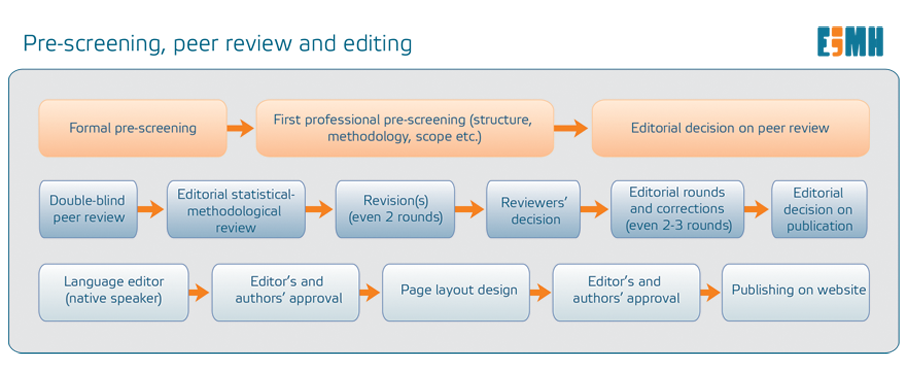
The Journal operates a double-blind peer review system in which the reviewers do not know the authors’ names and affiliations, and the authors do not know the reviewers’ identity.
In most cases, manuscripts submitted are judged by two, or in the cases of dilemmas up to three reviewers, who must assess according to a Peer-Review Checklist whether the manuscript is scientifically sound and coherent, presents interesting and unique results for the field, is methodologically correct and replicable, and is sufficiently clear and understandable for publication. Reviewers will also provide a detailed and coherent textual assessment and point out the need for minor or major revisions within the manuscript. The editors will decide on the basis of these reports whether to revise and publish the manuscript. Following the revision process, the reviewers receive the manuscripts again and approve publication. Depending on the manuscript’s quality, authors may be asked to submit 1-3 rounds of revisions. One of the editors will be responsible for monitoring the revision process, confirming the reviewers’ requests and/or making formal, methodological, and professional suggestions in addition to those made by the reviewers.
If the reviewers do not consider a manuscript worthy of publication, the editors may still decide to publish a manuscript, and conversely, they may also decide to reject a manuscript while the reviewers have accepted it.
One of the Associate Editors carries out the monitoring of the review process. From 2024, all manuscripts in the peer review process are read and also reviewed by a Specialist Editor who is an expert in statistical methodology.
Editorial Workflow
The Journal’s professional supervision is provided by the Editor-in-Chief, a multi-member editorial office headed by a professional coordinator, and an International Editorial Board.
Psychologists, sociologists, and doctors make up the editorial office. The International Editorial Board consists of representatives from different disciplines, professions, and countries.
The pre-screening of manuscripts is carried out in three rounds by the Editorial Secretary and two Editors of the Editorial Office. One of the Editors carries out the monitoring of the review process. From 2024, all manuscripts in the peer review process are read and reviewed also by a Specialist Editor who is an expert in statistical methodology.
Post-Publication Amendment Policy
Purpose
This policy defines how the European Journal of Mental Health manages corrections, retractions, expressions of concern, and removals in line with the COPE Retraction Guidelines (2025). Its aim is to ensure transparency, accountability, and the integrity of the scholarly record.
Types of Amendments
Correction (Erratum or Corrigendum): A correction is issued when an error affects clarity, data accuracy, or interpretation but does not invalidate the main conclusions.
- Erratum: issued for publisher or production errors.
- Corrigendum: issued for author errors.
- Each correction clearly states what has been changed and is linked to the original article.
- The corrected version remains part of the permanent scholarly record.
- Minor typographical mistakes that do not affect meaning do not require a notice.
Expression of Concern: An Expression of Concern may be published when serious doubts exist about an article, but the evidence is incomplete or an institutional investigation is pending.
- It alerts readers without drawing premature conclusions.
- It must later be replaced by a correction or retraction once findings are confirmed.
Retraction: A retraction is issued when an article’s findings are unreliable due to error, misconduct, or loss of trust in data integrity.
Grounds include: fabrication, falsification, plagiarism, undeclared conflicts of interest, manipulated peer review, fake authorship, or paper-mill involvement.
Process and principles:
- The decision is made by the Editor-in-Chief, supported by the publisher and, where relevant, the author’s institution.
- Retractions are not delayed by slow institutional procedures if sufficient evidence exists.
- The notice must:
- Be clearly labeled “Retraction: [Article Title]”;
- State who initiated it (authors, editors, or jointly);
- Explain the reasons factually and without defamatory language;
- Be open access and linked to the article.
- The original article remains accessible but is watermarked or marked on every page as “Retracted.”
- Partial retractions are discouraged; full retraction is preferred when major parts are unreliable.
- Batch retractions for coordinated manipulation (e.g., paper mills) must specify the shared cause.
Article Withdrawal and Removal
- Withdrawal: for articles that have been accepted but not yet formally published, when critical issues arise before publication.
- Removal: used only for legal or safety reasons (e.g., court order, defamation, copyright breach, privacy violation, or public health risk).
- In all cases, bibliographic metadata remain visible, and a public statement explains the reason.
Republication / Replacement: If a retracted paper can be replaced with a corrected version that passes peer review, it is treated as a retraction plus republication.
- The new version must include a clear note of replacement and a link to the retraction.
Procedure
- An error or concern is reported.
- The editorial office conducts an investigation following COPE flowcharts.
- Authors and institutions are consulted for evidence or comment.
- The Editor-in-Chief determines the appropriate action.
- A public notice is issued (correction, expression of concern, retraction, or removal).
- All notices are dated, signed, citable (with DOI), and indexed for transparency.
- The original article’s record is never deleted; updates are permanently visible.
Transparency
The journal ensures that all amendments are freely accessible, clearly labeled, and traceable in indexing databases. All actions follow COPE’s principles of integrity, accountability, and transparency.
The journal also treats the misuse of Artificial Intelligence (AI) tools as a form of research or publication misconduct. AI-generated content must be transparently disclosed and appropriately used in accordance with the journal’s authorship and ethical policies. Undisclosed or deceptive use of AI in generating text, data, or images may lead to correction, retraction, or other editorial action as deemed appropriate.
All decisions regarding corrections, retractions, or editorial notices are made by the Editor-in-Chief in consultation with members of the Editorial Office, ensuring fairness, accountability, and consistency.
Further details are available in the official COPE Retraction Guidelines (2025)